
Chautauqua County Wanted Fugitives
The Sheriff’s Wanted Top 10 page posts photo-bearing notices. The agency picks who to feature. It is a public-safety list. That makes it distinct from the Chautauqua County Jail roster, which tracks current custody rather than fugitives. The “Top 10” label is loose. The count you see may be smaller, entries come and go, and no update schedule is published.
Each entry is a warrant-related notice tied to an issuing agency and court. Photos and individual notices stay under the Sheriff’s control on the official source. Read them as leads. The current layout of the Sheriff’s Wanted Top 10 page appears below as a source interface rather than a copied gallery.
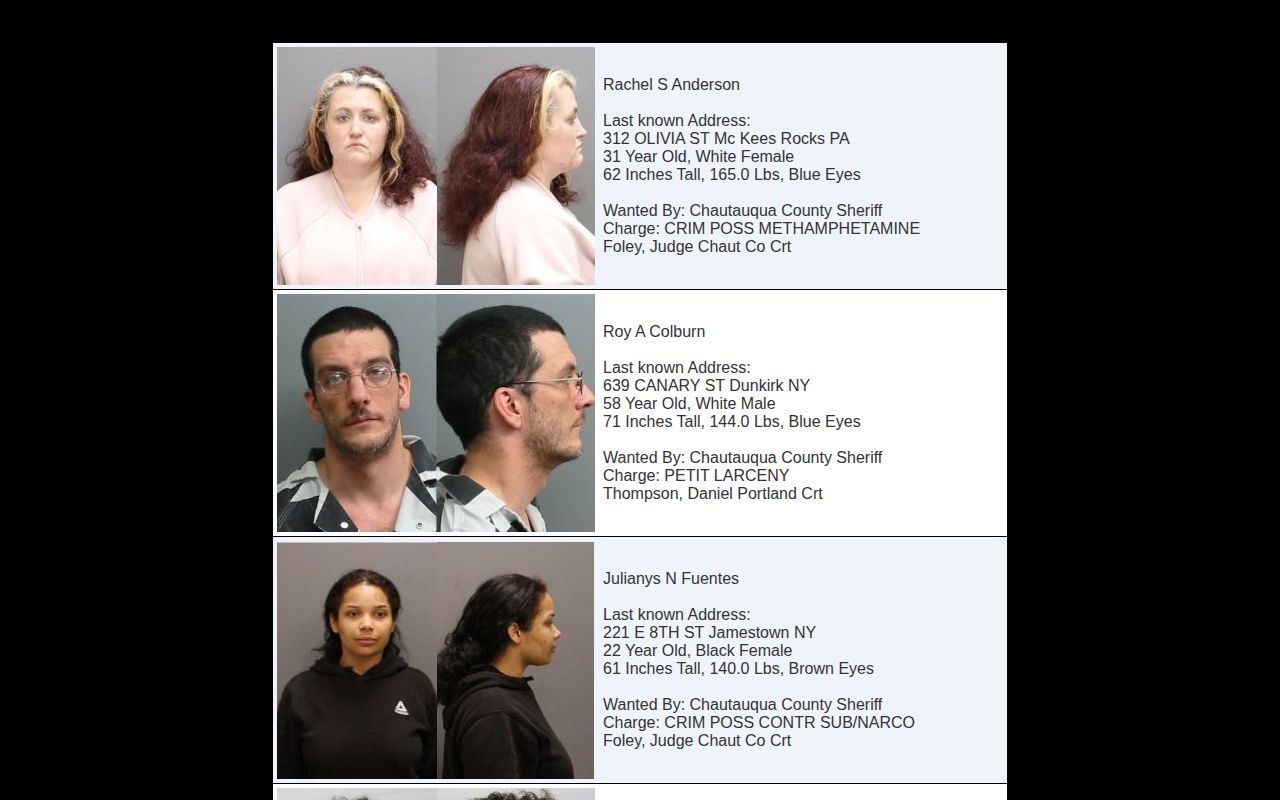
The screenshot simply shows how the official page presents itself. Any given entry may already have changed.
Chautauqua County Wanted Listing Fields
A notice offers more than a name. Its fields tie together the identity of the person, the agency doing the looking, and the court reference. Repeat each field exactly as the Sheriff displays it. One caution: a last known address is historical context for identification, not proof of where someone lives now.
| Field | What the Sheriff page displays |
|---|---|
| Name | The identity used for the wanted notice. |
| Last known address | Historical location information, not a current-location claim. |
| Age, sex, and race | Demographic descriptors shown with the notice. |
| Height, weight, and eye color | Physical traits supplied to help distinguish a listed person. |
| Wanted agency | The agency connected with the public notice. |
| Charge | The charge or charge language shown by the source. |
| Court or judge | The court reference provided for the listed matter. |
Expect gaps. A notice may leave out a booking date, custody status, or the full case history. For a current-custody question, the Chautauqua County Jail roster is the better tool when it has an entry. The court, in turn, handles what became of the charge.
Note: The number of entries you see reflects the page at one moment, not a fixed total or posting schedule.
Read Chautauqua County Most Wanted Safely
Treat a public wanted notice as information, not a mission. Confirm the source page. Keep the agency’s wording intact. Let trained personnel chase tips. Comparing photographs on your own, or acting on an unverified report, can go badly wrong. A name might also show up in a booking record somewhere. That does not make the two sources the same. One is a wanted notice. The other is a custody record, and each answers a different question.
- Open the official Wanted Top 10 page and read the agency, charge, and court fields together.
- Check the date and source context before repeating a name, address, or charge from the notice.
- If a person may be in immediate danger or a crime is occurring, call 911 rather than trying to make contact.
- For a non-emergency tip, use an approved tip channel and provide only what can be shared safely.
- For a current-custody question after an arrest, use the county’s official booking and roster sources, which are separate from the wanted notice.
Chautauqua County Anonymous Tip Options
Regional tips can go to NYS Crime Stoppers at 866-313-TIPS (8477). The service describes itself as anonymous. Its materials note that reward eligibility requires qualifying information leading to an arrest and conviction. Crime Stoppers WNY has also been reported to cover Chautauqua County plus its neighbors, taking tips by phone, web, and app. Check the tip service’s current instructions before assuming any reward applies.
Tip and emergency contacts
NYS Crime Stoppers: 866-313-TIPS (8477)
Jamestown Police anonymous tip: 716-483-8477
Dunkirk Police tip: 716-363-0313
Emergency: 911
Local lines make sense when your information involves those agencies. A tip line is not a private case-update service, a warrant-status checker, or a place to negotiate. The Sheriff’s materials point tips toward proper channels. If danger is immediate, call emergency dispatch.
Check Chautauqua County Warrants
The Sheriff also runs a separate warrant search. Its Alpha List pulls warrants together, and an agency-patch filter narrows results to one department. For a name-specific Chautauqua County warrant question, that makes it a more direct starting point than the curated fugitive notices. Finding a name there does not mean the warrant is executable today. The issuing court or agency confirms status. The page itself tells people with a warrant not to panic.
The official Alpha List and agency filter appear below. Its safety language directs readers to contact the issuing court or an attorney to arrange a next court date, and it warns the public against any attempt at apprehension.
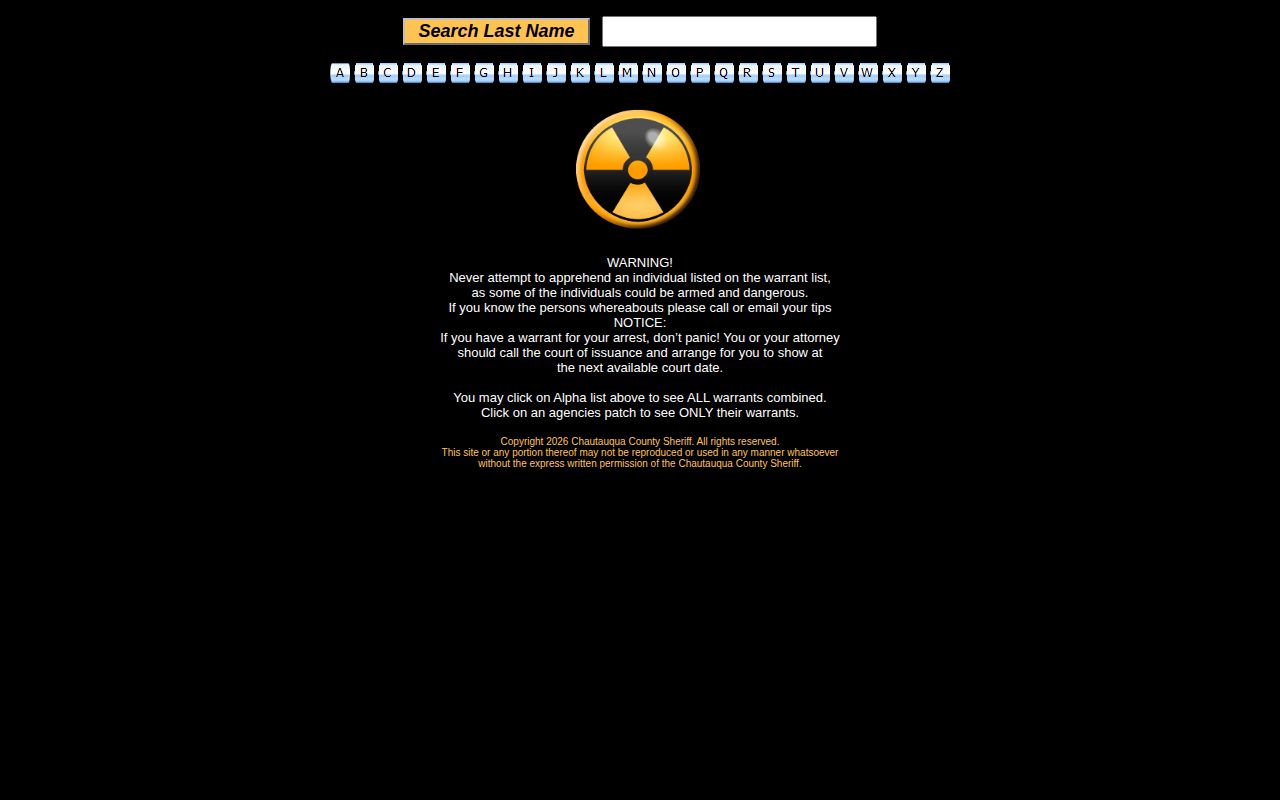
The page offers a public check, nothing more. Legal advice and official confirmation still come from the issuing court, the agency, or an attorney.
- Use the official warrant search and enter or locate the name carefully.
- Use the agency filter when the issuing agency is known, then retain the exact source wording.
- For a possible personal warrant, contact the issuing court or consult an attorney about the next court date and lawful resolution.
- For an outdated, unclear, or disputed result, ask the issuing agency or court to verify the record instead of relying on a screen result.
A warrant check is not a dodge around court process. It is a way to find the right official contact and settle a question safely.
Chautauqua County Warrant Types
Source pages do not sort results into tidy categories. The terms below describe the usual roles of courts and agencies. They do not claim any particular result fits one box. What controls your next step is the wording on the specific Chautauqua County result, plus whatever the issuing court or agency says.
| Term | What it generally signals | Safe next contact |
|---|---|---|
| Arrest warrant | A court-authorized warrant associated with an alleged offense or investigation. | Confirm the case with the issuing court, agency, or an attorney. |
| Bench warrant | A court-issued warrant tied to an existing court matter, often requiring the court’s direction. | Contact the court of issuance or an attorney about lawful scheduling or appearance. |
| Agency-listed warrant | A result associated with the agency selected in the Sheriff interface; the label alone does not prove present validity. | Ask that agency or the issuing court to verify the record. |
Wanted and in custody mean two different things here. A wanted notice tells you the Sheriff is looking for someone. A jail roster entry tells you someone was booked. Neither one explains the other, so read each with its own label in mind.
Chautauqua County Court Resolution
The Sheriff's warrant page sends people to the issuing court or to a lawyer. That is the right door to knock on. The court controls the calendar and what happens to a case down the line. New York eCourts is a tool for finding a case, though the court system itself cautions that online results are incomplete. Sealed matters, youthful-offender matters, and cases not yet entered may simply not show up.
Once a case wraps up, the court's certificate of disposition is the document that counts. It is sealed by the court. It can show the charge, any conviction, the date, and the sentence. No arrest record, warrant, booking entry, or news story can stand in for it. Charges also get reduced or dismissed along the way.
Note: A case missing from an online search does not prove a warrant or court matter never existed.
Chautauqua County Sheriff Alerts
The Sheriff's office runs a mobile app, listed on Apple and Google Play. It gathers tips, alerts, crime reporting, news, and public resources in one spot. A 2020 launch report promised even more. That list included inmate information, status-change notifications, and most-wanted material. The current store descriptions leave some of those features out, so look inside the app before you count on any of them.
The Android app listing is an official source. Treat the app as an alert and public-safety channel, not as a searchable booking-photo archive.
Sheriff's Office announcements show up on Facebook and on its X account, where wanted-person notices and public-safety alerts get posted. Treat them as bulletins rather than a searchable booking roster.
Chautauqua County Wanted List Limits
The wanted notice and the warrant search do different jobs. Neither one tells a person's whole story. The Sheriff publishes no fixed update schedule for either. A result you find may be stale, changed, recalled, or already resolved, and the real answer may sit in a court file you cannot see online. Keep the agency's exact wording. Never match on a name alone. Confirm with the court or agency that started the matter.
The county jail holds more than fresh Chautauqua bookings, too. Per the Sheriff, its population mixes people awaiting court, people serving county sentences, parole and probation violators, civil detainees, and people accepted from federal or immigration agencies. A photo or record from one source cannot tell you where someone lives or how another agency's case stands. Verify identity and status with the originating agency first. Court records hold the final outcome.